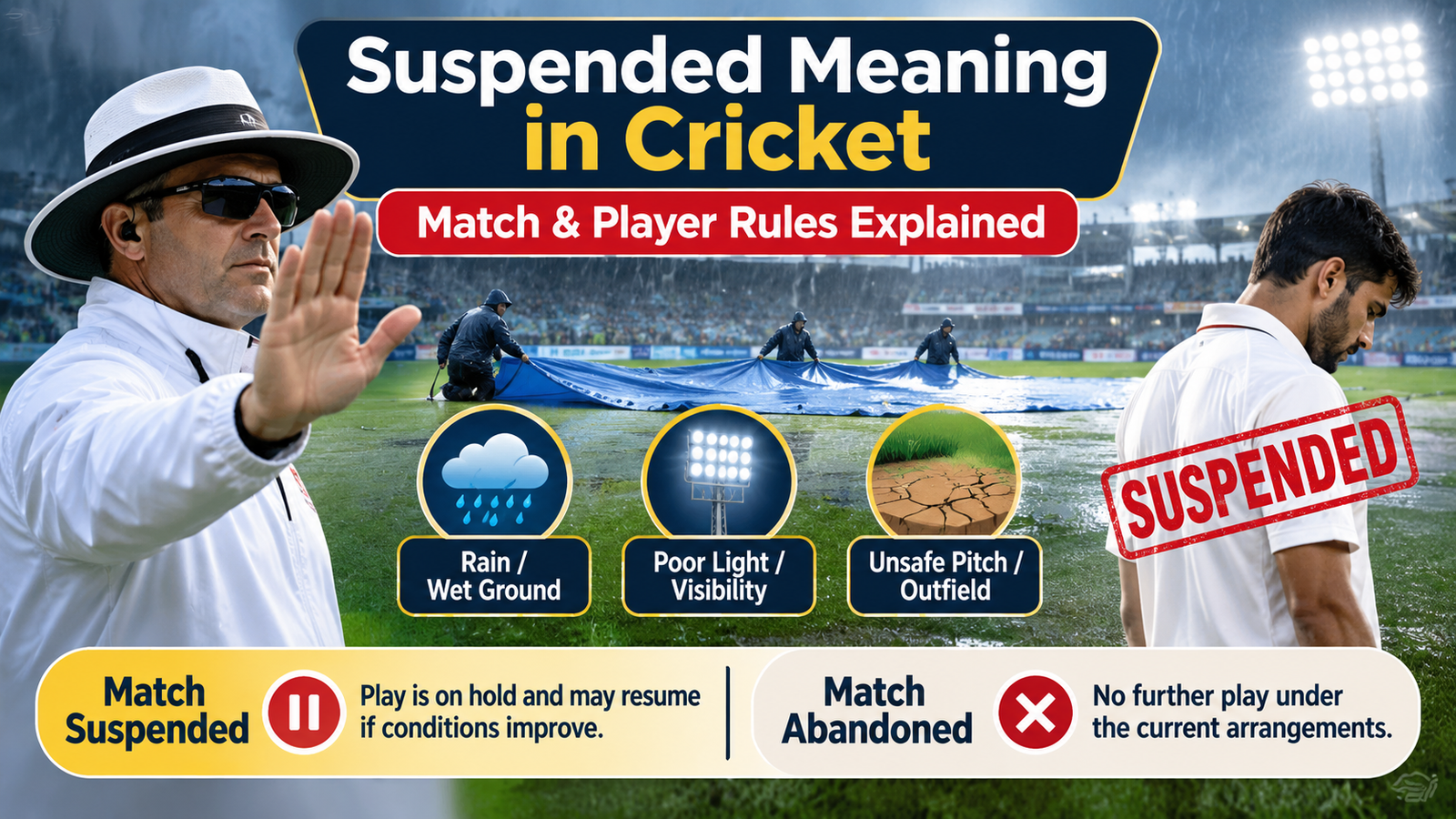

A Suspended Meaning in Cricket of a cricket game occurs when players must stop playing due to safety concerns or other reasons that render further participation in the game impractical. Weather events like rain, bad lighting, unsafe pitch/ground surfaces, etc., are all examples of situations that lead to suspensions. When a suspension takes place, however, the game does not necessarily get abandoned or cancelled. If conditions change for the better, then players will be able to begin playing again.
A suspended cricketer can have a temporary ban on playing in matches as a result of disciplinary breaches or other relevant regulations.
The resumption of a suspended match, reduction in overs for a match, or the end of a match prior to completion will be determined by the specific situation and rules of the competition.
What Does SSuspended Meaning in Cricket?
In the world of cricket, “suspension” indicates that the game is on hold. The officials of the match have the ability to call off a match prior to it being played due to safety concerns, or to stop a match once it has already commenced.
The umpires could decide to suspend a Twenty20 cricket game if it starts raining heavily. If the ground or the playing area gets too wet to be safe, then the umpires can stop the game until they can determine if the conditions will allow for the game to resume.
The game could restart if the rainfall ceases and the playing field is once again safe for play. However, should the weather conditions continue to be unfavorable, the officials could possibly call off the game.
The difference between the two terms is that suspension refers to an interruption in play, but may not be the final result of the game.
The authority to stop, prevent from starting or resuming play, when conditions such as the ground, weather, light or other factors are either unsafe or impracticable is given to umpires under MCC Law 2.8.
Why Are Cricket Matches Suspended?
Many reasons exist for why a cricket match may be delayed. Some examples include, but are not limited to, player safety concerns, as well as weather conditions which create an unsafe environment to play.
Rain and Wet Ground Conditions
Rain is among the most frequent reasons for cricket match delays. When there is a lot of rain, the playing area may become very slippery, have large amounts of standing water on the field, or provide dangerous playing conditions for all players.
Officials will likely have to check out the area once the rain has stopped and make sure that it’s okay for players to get back on the field. The fact that the grass is wet does not necessarily mean that the field is too dangerous for use.
Poor Light or Visibility
Cricket is an activity where players have to be able to see and follow a fast moving ball. If the ability to view the ball is severely restricted because of poor visibility, (such as during the evening hours or with inadequate lighting) umpires can stop the game.
Dangerous Pitch or Outfield
In addition to the aforementioned issues with playing surfaces being unsafe, an excessive slipperiness of the outfield or a damaged pitch can lead to a condition where continuing to play will be harmful.
Officials must assess whether the problem makes play unsafe or unreasonable.
Unexpected Safety or Technical Problems
Unexpected events, such as security concerns, floodlight failure or other unplanned events can disrupt a game.
In general, though, not every type of delay will be categorized as a formal suspension. The reasons for stopping the game and the rules of the particular game being played will help define what actions can be taken by the official(s).
What Happens After a Cricket Match Is Suspended?
A suspended cricket match may resume, be shortened, or end without further play.
Match official(s) determine if play can resume based upon the current conditions of the pitch/court. A decision to restart will depend on how much time remains for play, the type of match being played (i.e. Test Match vs One Day International) and the governing body’s rules of the competition in which the match is taking place (i.e., ICC Playing Conditions).
If conditions are acceptable: When the officials determine that play is safe, play will resume at the same location as when play was suspended.
If there’s significant loss of time: When playing in limited over cricket, the officials can cut back on the amount of overs that each team will have access to. Typically, one over consists of six valid deliveries.
The match will be stopped if it cannot be continued; at that point, the match will be declared as abandoned by the officials. Depending on how much of the game has been played, as well as the rules governing the competition, there may either be a result or a non-result.
How Does the DLS Method Work in Suspended Matches?
The Duckworth-Lewis-Stern (DLS) method is applied to many of the rain-affected limited overs matches.
The system sets the target and assists in determining the outcome based upon what resources (i.e. overs remaining, wickets lost) are still at the disposal of each team.
If a 50-over match is interrupted by rain, and the chasing team has their innings cut short, the officials will determine the revised target using the DLS method.
DLS is not applied every time a cricket game is suspended. The application of DLS will be determined by the type of game being played, the amount of time that was available to complete the game and what the rules are for the competition.
Some of the tournaments have planned extra time for some of the matches. Whether the game may go on at a later date depends on how well these plans were made.
Suspended vs. Abandoned, Delayed, Interrupted and Postponed
The terms used in live cricket updates may be used interchangeably at times, but each term refers to a different scenario.
| Match Status | Meaning | Can Play Continue? |
|---|---|---|
| Suspended | Play is temporarily stopped | Yes, if conditions permit |
| Delayed | The scheduled start or resumption is late | Usually, once the issue is resolved |
| Interrupted | Play has begun but is temporarily stopped | Yes, depending on conditions |
| Postponed | The match is rescheduled for a later time or date | Yes, under the revised schedule |
| Abandoned | No further play will take place under the current match arrangements | No ordinary resumption; the outcome depends on the rules |
For example, suppose rain begins during an IPL match.
The umpires will call a halt to the game when the outfield is no longer safe. This will result in a suspension or interruption of the game.
When the rain ends and the playing surface is deemed safe for play, the game can restart; possibly with reduced number of overs.
If weather conditions remain too bad for the game to resume, the officials could call off the match.
A match that is suspended may still have a outcome and a match that is abandoned may or may not be called “no result.” Whether there is a final score or not depends upon how much time was played before the suspension/abandonment and the rules of the particular tournament.
Some times these two types of delays may overlap. For example, if a match was due to begin at 10am on Saturday but has been put back until 2pm on Sunday because of rain, and then is cancelled due to poor weather, the match will have been delayed and cancelled.
What Does It Mean When a Cricket Player Is Suspended?
When a cricket player receives a suspension, the player cannot take part in certain types of cricket matches or cricket-related activity for a period of time.
In contrast to being suspended from playing (a “match suspension”), when you have been suspended as a player, you cannot participate in any games. These types of suspensions are normally given due to some form of disciplinary action or other limitations that were placed on you by cricket rules.
Common reasons for disciplinary suspensions include:
Serious misconduct during a match.
Breaching the applicable code of conduct.
Repeated disciplinary offenses.
Other serious violations covered by cricket regulations.
The International Cricket Council (ICC) has an active disciplinary process using the Code of Conduct. Under this code, players can receive fines, demerit points, or match bans.
Under the ICC’s Demerit Point System, players who accumulate 4 or more demerit points in 24 months will receive suspension points and may face a match ban. The ICC Disciplinary Guidelines state that two suspension points are equivalent to a ban from either one Test Match or two One Day Internationals (ODIs) or Twenty20 Internationals (T20Is), whichever occurs first.
A two game suspension for a player would prevent them from playing in those two games. That means the team will have to go ahead and play without the suspended player for the duration of the suspension.
The length and circumstances surrounding a player’s suspension are determined by the seriousness of their action(s) and the policies set forth by the governing body.
The distinction is simple: when a match is suspended, it means that play was put on hold for a period of time; whereas, if a player is suspended, he/she cannot participate.
SEO Metadata
SEO Meta Title: Suspended Meaning in Cricket: Essential Rules & Bans
Meta Description: Find out what it means to be suspended during a cricket match, why matches can be halted, when matches can resume, the role of DLS in determining outcomes, and the differences between match delays and player suspensions.
SEO URL Slug: suspended-meaning-in-cricket